Consumer technology often appears docile. Subservient. Inactive, unless summoned by its user. In practice, however, your tech is always full of life, working at incomprehensible speeds and processing unbelievable amounts of data—and never taking a rest. And all this life is completely invisible.
Your phone is rammed full with sensors taking secret readings at rates faster than you can comprehend and storing this in undisclosed locations. Invisible.
Your computer runs on software written in a programming language that has been converted into non-human-readable files which live on the device and cannot be deleted. Invisible.
Your computer takes your data and beams it across the world in packets of electromagnetic radiation which travel at the speed of light. Literally invisible.
The life of your tech is indeed invisible, but this is not due to any universal law or fundamental principle. The life of your tech has been artificially made invisible exclusively to you, the user.
Invisible people#
Consider the following ridiculous short story.
You’re walking through a park with your friends and you all decide to take a group photo. Everyone knows their roles - it’s a well-rehearsed routine. You’re the designated cameraman, so you unlock your phone and turn on the camera. Your friends automatically position themselves behind you in anticipation. However, just as you begin to raise your arm up into position, a masked man rushes in front of you and in one smooth motion he grabs your phone, sits on a nearby bench and connects the phone to his laptop. The absurdity of the situation leaves you all stunned but before you can even set aside your shock and react to this man, he disconnects your phone, stands back up, and returns it to you - his actions are an almost perfect reverse of how the phone was initially snatched (it appears he too has a well-rehearsed routine). “Done” he says. He runs off.
The phone was out of your hands for maybe 10 seconds. You’re flustered, but your friends are still in position.
(And now to make this story thoroughly ridiculous)
You raise your arm and take the photo.
Now that story was probably very boring and certainly unbelievable, but it can be used to make a valid point. Believe it or not, but the masked man in my story is real and has been performing these actions on you for years, though in reality his actions do not leave you flustered, for his actions are silent. This masked man is real and his name is “Software”. Every time you use your tech, Mr Software is hard at work behind the scenes. And you behave as if his actions do not matter. Why? Because Mr Software is invisible.
In the hopes that maybe this point will stick, understand this:
Software is a person.
Software is a person? Yes. It sounds strange but the word choice is intentional. Now, software may not be a real person in the most literal sense, but software is a person in the sense that every single action performed by software was designed by a person. If your software listens to you, if it records you, if it automatically transmits your data, if it decides to promote certain ideas in particular months of the year, it is because a person made it so. In many cases, if there is software in your room, a person is right there with you.
There are things you would not do if a stranger was in the room. Apply it to your tech.
Invisible data#
You probably already have a reasonable idea of what data is: information. Metadata, on the other hand, might be a new concept to you. Simply put, metadata is data about data. Some examples:
-
That text file on your laptop? Data. The file size information displayed alongside it? Metadata.
-
That private message you just wrote on your favourite state-sponsored messaging app? Data. The “sender” and “recipient” tags attached to that message? Metadata.
-
Your heart rate readings, taken by your smart watch? Data. The exact GPS coordinates at which each heart rate reading was taken? Metadata.
The tricky thing about metadata is that, although it can be useful (crucial, even) in some contexts, it is often generated via automatic processes outside of the awareness of the user. Invisible.
What’s in a selfie?#
Have you ever considered what kinds of hidden processes are automatically triggered every time you take a photo on your phone? If not, it’s time to learn about something called EXIF data. EXIF data is a type of metadata that’s used for image files. Inside every picture taken on your phone, invisible to you, is EXIF data: hundreds of additional tags of information captured at the moment the picture is taken.
If you’re curious to see what EXIF data looks like, you’ll be pleased to know that the procedure is quite straightforward, though a brief detour into some somewhat technical topics is first required. If you are on a desktop/laptop computer with access to a program called a “shell”, an image file’s EXIF data can be viewed by entering the following command:
> exiftool <file_name>
exiftool is the name of the program being used to analyse the image file. <file_name> is just a placeholder for the real name of the actual file under inspection. In practice, you might write a command that’s more like:
> exiftool "private selfie.jpeg"
Once this command is executed, a long list of hidden data will be displayed on your screen. Here is an example of the result.
Now that’s a lot of information. Whilst it may be difficult to understand exactly what all that metadata means, understand this: most (if not all) of that metadata is not necessary for the file to function and is only captured because the makers of the technology know they can do so without the user noticing/caring.
Invisible lies#
If you reviewed the sample list of EXIF data mentioned above, you may have noticed that “GPS” is mentioned a number of times.
What exactly does GPS data have to do with a photo? Exactly why are your exact coordinates being silently embedded into all your selfies, without your permission or awareness? With a little bit of basic deduction, at least one concerning reason emerges. Read on.
In your smartphone, there is a “permissions manager”. This is simply an area in the settings where you can restrict the functionality of your apps by enabling/disabling permission to access certain areas of your device. For example, your smartphone has GPS functionality embedded inside of it and you can use the permissions manager to select which apps have access to your GPS location. Now, consider your favourite social media app. Instagram, perhaps. Imagine that you used your permissions manager to give Instagram access to your file storage (so that you can share your lovely mirror selfies), but you denied it access to your GPS data because you understand that Instagram does not need to know your exact location.
Now consider your camera app. What if you had used your permissions manager to grant your camera app access to your GPS location? In such a case, Instagram would still effortlessly have access to your GPS location, even though you denied it access through your permissions manager. How? Because you gave Instagram access to all your photos, and you gave you camera app access to your location. So, all your photos contain EXIF data that includes your GPS location - and you handed this EXIF data directly to Instagram by allowing them access to your storage.
What just happened? Didn’t you deny Instagram access to your GPS location? Well, yes. However, your permissions manager pretended to be your friend, but in reality, from the moment you finished saving your settings, your permissions manager was busy making back alley deals with all your other apps and allow them to exploit hidden connections you didn’t even know existed. You explicitly said “Don’t give Instagram access to my location” and yet Instagram still has access to your location. And not a single rule was broken. Well, how? Were you hacked? No. Simply put, Instagram know the rules. And you do not.
If the explanation is still unclear, consider the photo below. Whilst the permissions manager can deny Instagram direct access to your location, Instagram can still obtain indirect access, through an alternative route.
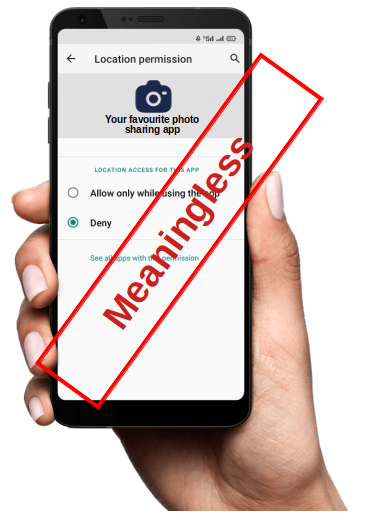
Invisible.
It is likely the case that several apps on your phone are silently and mercilessly scraping all the metadata from any photo (or file) to which you grant it access. Understand the principle.
Understand the principle further. You are being lied to. And the invisible nature of software facilitates this deception.
The above is only one example. Take any technology you frequently use and you will likely be severely underestimating the degree to which it preys on your ignorance about its hidden processes.
Invisible indifference#
It is serious cause for concern that most consumer technologies harbour invisible people who manage invisible data, silently and constantly telling users invisible lies. What power do you have in such a situation? None. This is abuse.
Tech companies are acutely aware of the degree to which they weaponise the invisible layer smuggled into their products. How do they ensure there’s no user backlash against all this deceit? By weaponising the visible layer also. By ensuring that everything the user interacts with is maximally entertaining, maximally convenient, so that they are unwilling (or unable) to seriously consider the dirty tactics which lurk just beneath the surface. By trapping users inside convenient “ecosystems” (i.e. prisons) that make even just the thought of using an alternative unbearable.
Indifference by design. Buyer beware.
You do not have to stay indifferent. You can remove Mr Software’s invisibility cloak and neutralise the threat.
SUBDUE.